I have watched a lot of AI demos in the last three years. Most of them are a magic trick performed under perfect lighting: the scripted question, the tidy answer, the applause. So when my phone system offered me an AI agent that would answer real calls from real strangers who mumble, interrupt, and call from moving cars, my expectation was somewhere between 'embarrassing' and 'actively harmful to my business'. Eight weeks later it is still answering my phone, and I want to tell you precisely why - including the parts where it isn't magic.
Who I am
I'm Oscar. I run a two-person video production studio - me on camera and edit, one producer who is usually on a shoot or asleep. We are exactly the size where every operational tool has to earn its keep in hours saved, and where nobody exists to answer the phone. I am also, professionally speaking, an AI tools guy: I automate what I can, and I've been burned enough times to distrust anything that promises to think for me.
The problem with being two people
Our inbound calls are low volume and high stakes. Maybe six a week. But one of them is a production company asking if we're free for a two-day corporate shoot, and if we don't reply before they call the next studio, that's a five-figure month gone. Voicemail is where those calls go to die. I know this because I lost one and then, mortifyingly, listened to the voicemail four hours later while it explained exactly what I had missed.
We went with someone else - you weren't picking up and we needed to lock a crew that day.
Nobody is villainous in that sentence. That's just how booking works. But it made the tradeoff explicit: I could either be interruptible all day, which destroys editing, or I could keep losing the calls that matter most.
What I tried (and why it failed)
- A traditional voicemail greeting with my email in it - callers almost never converted to email. People who call want to talk now, not compose.
- A cheap AI receptionist app I found through an ad - it hallucinated a service we don't offer and quoted a price I have never charged in my life. Deleted in three days.
- Do Not Disturb plus scheduled call-backs - disciplined, tidy, and completely useless for time-sensitive booking calls.
The turning point
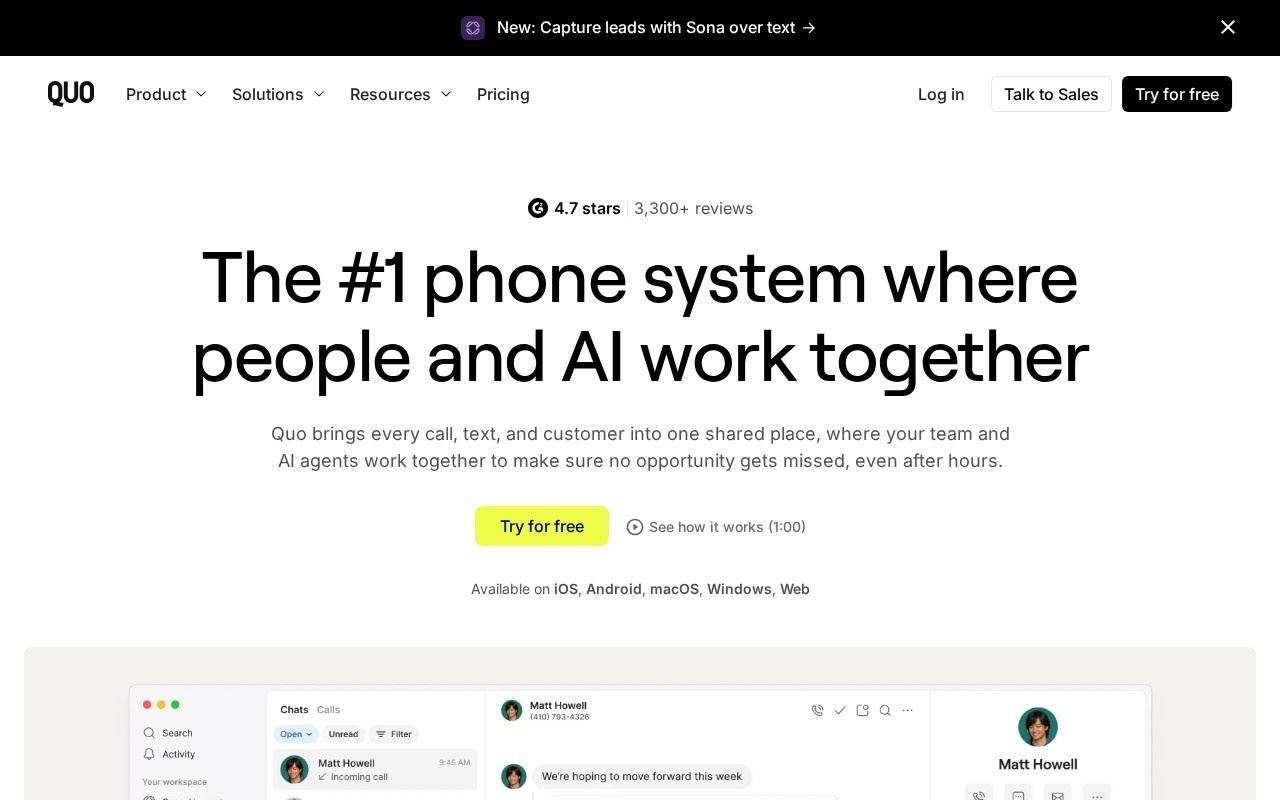
I was already moving our number onto Quo - the business phone platform that used to be OpenPhone - mostly for the shared inbox. Their AI agent, Sona, came included on the plan, which lowered my resistance considerably: I wasn't buying an AI product on faith, I was toggling on a feature of something I already needed. I gave it our real business context, set it to pick up when neither of us could, and then went back to editing with the specific dread of a man who has left a robot alone with his reputation.
What it actually does well
It answers, and it captures
- Sona picks up when we can't - during shoots, during edits, after hours - and handles the front half of the conversation: who are you, what do you need, when do you need it.
- For me: I get a clean summary instead of a voicemail I have to decode. Name, project, timing, what they asked. That's a lead, not a notification.
- It also captures leads over text now, which for our audience is honestly the more natural channel.
It knows when it isn't the right answer
- The thing I actually respect: it doesn't try to close business it can't. Pricing questions, creative scope, availability on a specific date - it takes the details and hands off to a human instead of inventing an answer.
- For me: after the hallucinating-app disaster, 'declines gracefully' is a headline feature, not a limitation. An AI that knows its edges is worth more than one that improvises past them.
The AI stack around it
- Call summaries and transcripts on the Business plan mean every conversation is searchable text - which for a small studio is institutional memory we simply never had.
- There's a ChatGPT / Claude MCP integration, so my own AI tooling can reach the call and message data directly instead of me copy-pasting between apps. That's the part that made me sit up as an automation person.
- Standard integrations - HubSpot, Salesforce, Slack, Zapier - are all there if you're running a real CRM behind it.
The honest math on credits
This is the part reviews skip, so here it is plainly. Sona runs on credits: one call costs 100 credits, and every plan includes 1,000 credits - so ten AI-answered calls a month at no extra charge. That covers a studio like mine with room to spare. If you're a busy home-services company fielding dozens of calls a week, you'll move to a paid credit tier fast, and you should price that in before you get excited. Extra tiers run from $25 to $199 a month depending on volume, with per-call overage rates that drop as you go up. It's transparent, but it is not free forever, and anyone telling you an AI receptionist costs nothing at scale is selling you something.
The results that mattered
In eight weeks it has caught four calls that would have gone to voicemail. One became a booked shoot. That single job paid for the software for years, which is the sort of sentence that sounds like marketing copy right up until it happens to you. Less dramatically: I edit in longer uninterrupted blocks now, because the phone stopped being a threat. That's the real product - not the AI, the attention it gives back.
Isn't it dishonest to have a robot answer?
I thought about this seriously, because I don't want my business to lie to people. My conclusion: the honest comparison isn't 'AI versus me answering' - I wasn't answering. It's 'AI versus voicemail'. Sona doesn't impersonate me, and callers consistently behave like people who got helped rather than people who got tricked. If it ever pretended to be a human named Oscar, I'd turn it off that day. It doesn't, so it stays.
The new Oscar
The old Oscar treated every AI feature as a claim to be debunked, which was healthy and also exhausting. The new one has a simpler test: does it do a real job it can actually do, and does it know where its competence stops? Most AI products fail the second half. This one passes, and that's why it's the rare feature I stopped auditing and started relying on.
If your phone is losing you work
If you're a small team where nobody can answer the phone and voicemail is quietly costing you jobs, this is the most practical AI I've deployed all year - not because it's clever, but because it's scoped. Quo has a free trial, and the included credits are enough to see whether an AI answering your calls helps or embarrasses you.
Disclosure, plainly: if you sign up through a link on this page, AIStackVerdict may earn a small commission at no extra cost to you. It never buys a better review, as anyone who read our take on that other receptionist app can confirm. - Oscar
Community discussion
Enjoyed this story? Share your thoughts below.