

The contact form on my website has been sitting there for four years, patient and useless, collecting maybe one submission a month. Meanwhile my WhatsApp number - the one I put on Instagram once, casually, back in 2022 - became the single most valuable asset my business owns and the single biggest reason I stopped sleeping properly. That is the strange thing nobody tells you about selling online: your best salesperson and your worst bottleneck can be the same channel.
Who I am
I'm Priya. I run a small made-to-order furniture workshop - two makers who are excellent with their hands and hopeless with a phone, and me, who does everything else. Everything else means sourcing, quoting, scheduling, invoicing, the Instagram account, the website that is really just a catalogue, and every single customer conversation from the first 'hi, do you make bookshelves?' to the last 'it arrived, we love it'.
For a long time I was proud of that. People message a small workshop and a real human answers - that is the whole charm, isn't it? It is, until the charm becomes the constraint. I could not grow past the number of messages one person can hold in their head.

The bottleneck nobody warned me about
Here is a normal Tuesday from earlier this year. I wake up to a green badge on WhatsApp that I will not describe as a number, because the number embarrasses me. Most of it is the same four questions: do you ship to my city, how long does a custom piece take, can I see it in walnut, how much roughly for a two-metre table. I answer them one by one, from the workshop floor, with sawdust on my phone screen, and by the time I finish it is lunchtime and I have not done any actual work.
Then there are the evening messages. Somebody browses the website at 9pm, gets excited, messages, and gets nothing back until the next morning because I am asleep or with my family or simply done for the day. Excitement has a half-life. By morning they have found somebody else who replied at 9:04pm.
The one that finally broke me was a woman who wanted a full dining set. She messaged on a Thursday. I saw it, thought 'this one deserves a proper answer, I will write it tonight', and then did not. On Saturday she wrote again.
Are you still open? I messaged you yesterday.
She had waited two days, assumed the business was dead, and was being polite about it. I lost that sale. Not because my work was not good enough, and not because my price was wrong - she never got far enough to find out either. I lost it because I am one person with one thumb.
What I tried first, and why it failed
- Canned replies and labels. Helpful for about a week. They shortened the typing but not the deciding, and I still had to be awake and holding the phone for anything to happen at all.
- Hiring evening help. My cousin covered messages three nights a week. She is lovely, and she did not know what stain we can do on oak, so every real question came back to me anyway - now with a delay and a game of telephone in the middle.
- Pushing people to the website form. Nobody wants to fill in a form. They already have WhatsApp open; asking them to switch to a form is asking them to do paperwork before they are even a customer. My conversion did not improve, it just got quieter.
- A cheap scripted bot. This one I regret. It could send a menu of buttons and absolutely nothing else. The moment somebody typed a normal human sentence - 'hi, I saw the walnut sideboard, does that come in a smaller size?' - it looped back to the main menu like a bored receptionist. I took it down after nine days because it was actively worse than silence.
That last failure is why I spent most of this year assuming the whole category was not built for businesses my size.
The turning point
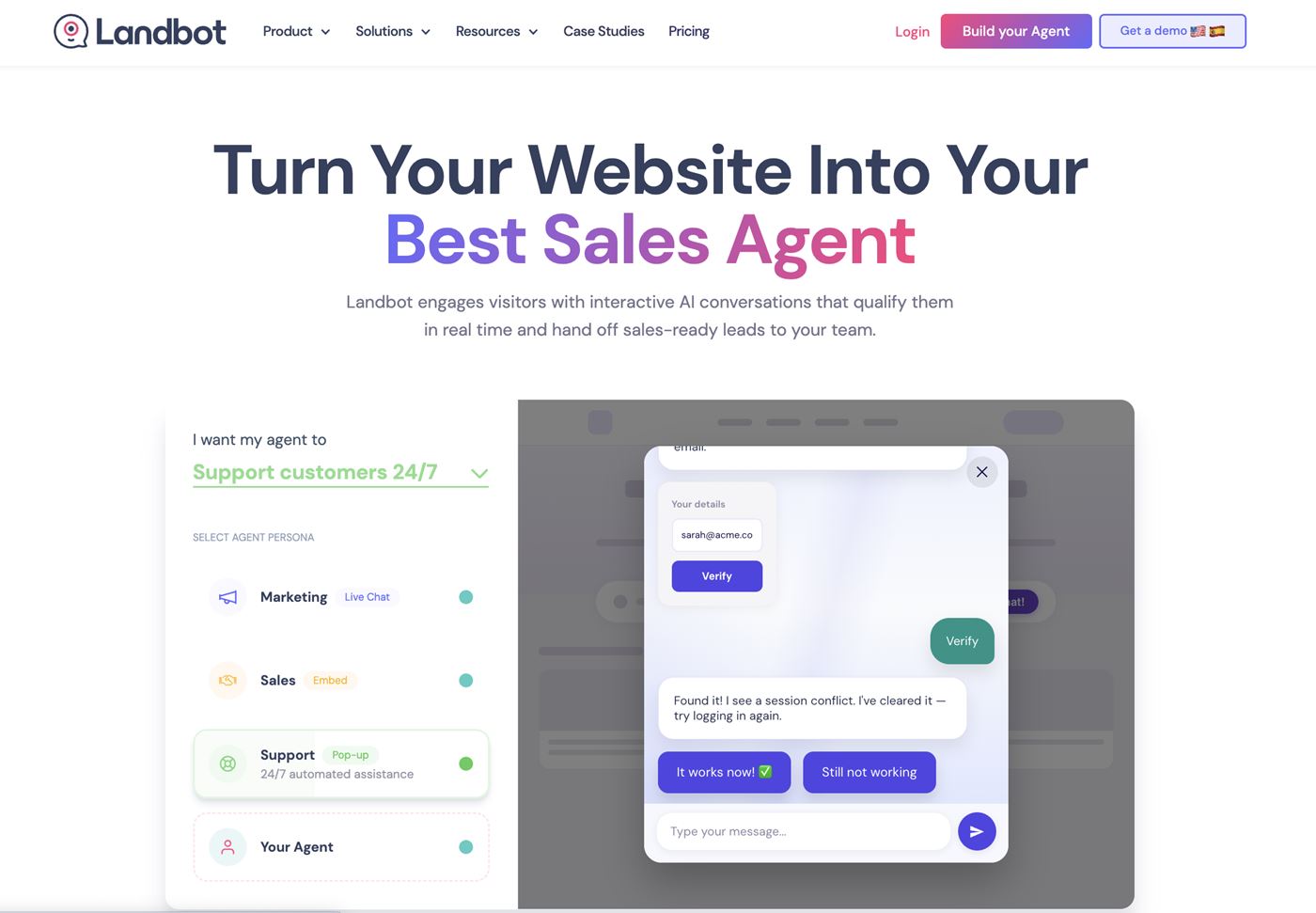
I found Landbot the way I find most things - a peer in a small-business group mentioned it, I opened the site expecting to close it again in thirty seconds, and then one line stopped me: 'Structured like a chatbot. Smart like an AI agent.' Their argument is that most tools make you pick one and that you should not have to. After my nine-day menu-bot disaster, that was precisely the sentence I needed somebody to say out loud. My problem was never that scripted flows are bad; it was that scripted flows with no intelligence around them are brittle, and open-ended AI with no structure around it is a liability when it is talking about my work on my behalf.
The other thing that made me keep reading was less romantic: the Meta Partner badge, sitting next to GDPR and SOC 2. WhatsApp is not a channel you want to improvise on. If I am going to let software speak to customers under my business name there, I want the boring compliance part handled by people who have done it before. Landbot's site says the company has been at this since 2015, and cites 12,000+ teams, 1B+ conversations, 190+ countries and a 4.7 average across 680+ verified reviews. Those are their numbers, on their own page, and I read them the way you should read anybody's homepage badges - as a reason to try, not as proof.
Then I actually tried the thing, and there was a moment I will describe honestly, because it is the moment that sold me. I typed what I wanted in plain English - an agent that answers questions about custom furniture, qualifies the serious enquiries and books a call - and the AI Copilot built the workflow. Not a suggestion. A drag-and-drop flow, sitting there on the canvas, greeting and qualifying questions and booking step already wired together. I sat back with my hands off the keyboard. I had been bracing for a week of building. I was looking at a first draft.
How I actually use it
What follows is my setup, not a feature tour. Anything I have not used, I have not written about.
The Copilot writes the draft, I do the editing
- I describe the job in a sentence, the way I would brief a new assistant, and get a whole workflow back instead of a blank canvas.
- Then I rewrite it in my own voice. This is the part that actually takes time - not the building, the wording. My first agent took an afternoon, and almost all of that afternoon was me fussing over how a question sounds coming from my workshop.
- For me: the value is not really speed. It is that I never have to start from nothing, which is the exact thing that killed every previous attempt.
Structure where it matters, AI where it does not
- The qualifying path is a flow I designed by hand: what piece, what timeline, what rough budget range, what city. Those answers have to come back in the same shape every time or they are useless to me.
- Around that flow, the agent handles the free-text questions people actually ask, grounded in a knowledge base of my own material - my wood options, my lead times, my delivery areas. Landbot's phrase for this is 'accurate, never invents', and the mechanism they describe is the one that matters: answers come from your content, with rules for control and AI for flexibility.
- For me: this is the whole reason I trusted it near customers. Software that improvises about custom furniture is not a helpful assistant, it is a future argument.
It lives where my customers already are
- The same agent runs on my website and on WhatsApp Business - the channel that was drowning me in the first place.
- The 9pm browser now gets an answer at 9pm. Not a fake answer pretending to be me, but an agent that handles what it knows and takes details for what it does not.
- For me: this single change did more than everything else combined, because my problem was never the quality of my replies. It was the hour they arrived.
Handing over to a human without making people repeat themselves
- When a conversation needs me, it reaches me with the full context attached rather than as a cold 'somebody is waiting'.
- The customer does not re-explain anything. I pick up mid-conversation already knowing it is the walnut sideboard, smaller size, delivery outside the city.
- For me: that is the difference between automation that helps and automation that quietly offloads work onto the customer. I read the handoffs; I no longer wade through the other ninety percent.
Where the enquiries end up
- Qualified enquiries land in my stack automatically instead of living as a screenshot in my camera roll. Landbot lists native integrations with HubSpot, Salesforce and 20+ tools, plus 500+ more through Zapier and n8n.
- My own setup is modest - I am not running Salesforce out of a furniture workshop - but the principle held: the enquiry arrives somewhere I will actually see it on Monday, in a shape I can work with.
- For me: no more copy-paste, and more importantly no more enquiries that never got written down anywhere at all.
What actually changed
I want to be careful here, because this is where reviews start inventing numbers. I am not going to give you a percentage. What I can tell you is what is different in my week.
The repetitive questions have left my life. Shipping areas, lead times, wood options, rough ranges - I have not typed those answers by hand in weeks, and they get answered at midnight as readily as at midday. The conversations that reach me now are the ones that deserve a maker's attention, and they arrive with the boring facts already collected, which means my first message to a serious customer is a good one instead of an interrogation.
And the quiet win, the one I did not expect: I stopped dreading my own phone. There is a particular low-grade anxiety that comes from knowing people are waiting on you and you cannot reach all of them. It is gone. My evenings came back.
The objection I had to answer
'Isn't a bot the opposite of what makes your workshop special?' I had this argument with myself for two weeks, and with a friend who runs a ceramics studio for one long dinner.
Here is where I landed. The charm of a small workshop was never that I personally typed out the delivery radius. The charm is the work, and the conversation about the work - the part where somebody describes their room and I say what I would do with it. Answering 'do you ship to my city' at 11pm is not craft. It was the tax I paid for the privilege of doing craft, and the tax was eating the thing customers came for in the first place.
There is also a version of this that would be wrong, and I want to name it. If I had let the agent try to be me - improvising about design, inventing a number to keep somebody engaged - it would have damaged something real. I did not, and the guardrails are the reason I could not do it by accident. That distinction is the whole ethics of it for me.
What I can and cannot verify for you
In the spirit of not being the kind of review I dislike: Landbot's homepage says customers see a 2-4x conversion lift within the first 60 days, and that your first agent can be live in about 15 minutes. I cannot confirm either from my own experience. I did not run a controlled test against a parallel version of my business without an agent, and I would not believe anyone who claims they did. My own build took an afternoon rather than a quarter of an hour, and that was my fault, not the software's.
The homepage also does not show prices. There is a pricing page, and their own FAQ answer to 'which plan is right for me' is essentially 'it depends on your channels and volume - book a demo'. If you are a small operation like mine, budget an honest conversation about volume before you fall in love with the builder. Start on the free option, build the agent you actually want, and only then work out what it costs to run at your size.
The new Priya
The old me measured a good day by how empty the inbox got. It was a terrible metric. It rewarded me for answering the easiest messages fastest, which meant the dining-set customer - the one who deserved twenty minutes of thought - was always the one I put off until Saturday.
The new me measures a good day by how many real conversations I had about real work. There are more of them now. Not because I found more customers, but because I stopped losing the ones who were already standing at the door, politely asking whether we were still open.
If your inbox is the bottleneck
If you are one person answering everything, and your best channel has become the thing you dread opening, this is the most useful category of AI tool for you - not because it is clever, but because it takes the part of the job that never needed a human and leaves you the part that does. Landbot has a free option, so you can build the agent, talk to it yourself, and decide whether it sounds like your business before you commit to anything.
Disclosure, plainly: this story is told from the point of view of someone running a small workshop, and the vague parts are deliberately left vague instead of dressed up as statistics. If you sign up through my link, AIStackVerdict may earn a small commission at no extra cost to you. It does not buy a kinder review - the scripted bot binned after nine days had an affiliate programme too. - Priya
Community discussion
Enjoyed this story? Share your thoughts below.