For years I believed I had an audience. I had a follower count I was quietly proud of, a feed full of hand-painted planner pages, and comments from people who called my work 'so calming'. Then I launched the product I had spent four months making, and almost nobody saw it. That was the week I learned the difference between followers and an audience. Followers belong to the platform. An audience is the people you can actually reach when it matters.
Who I am
I'm Hannah. I'm an illustrator, and I make printable planners, habit trackers and small art prints that people download and use at home. I work from a spare bedroom with a drafting table, a laptop, and a cat who believes the scanner is a heated bed. There is no team. There is no marketing department. There is me, a very long to-do list, and a phone I check far too often.
The internet made this life possible, and I'm grateful for that. But it is a strange, lonely way to earn a living. You can spend a whole day painting something you love, post it, and then sit there refreshing the screen to find out whether you are allowed to feel good about your work today. Some days the numbers said yes. More and more, they said nothing at all.
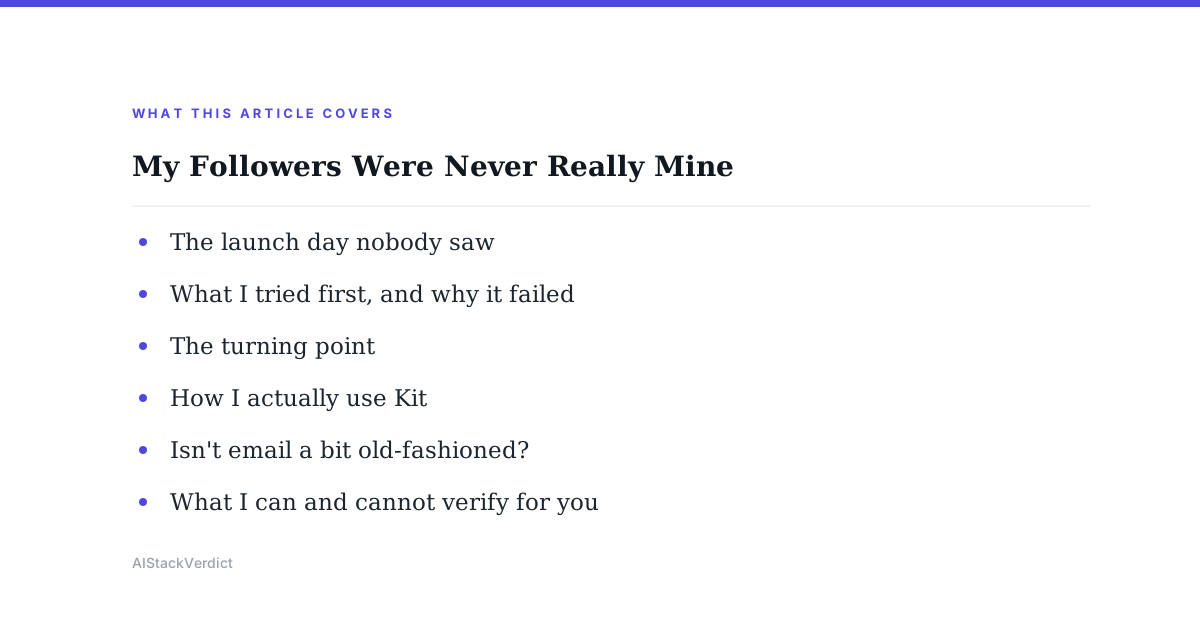
The launch day nobody saw
The product was a year-long planner, painted page by page in watercolour. I had teased it for weeks. On launch morning I posted the announcement, a carousel of the best spreads, and a short video of me flipping through the printed pages. Then I waited.
The post barely moved. The likes came from the same small circle of loyal people who like everything I share, bless them. The sales trickled in so slowly that I checked twice whether the checkout link was broken. It wasn't. The link worked perfectly. The problem was that the platform had simply decided to show my launch to very few of the people who had chosen to follow me.
A few days later, a woman left a comment on an unrelated painting. I have thought about it more than any compliment I have ever received:
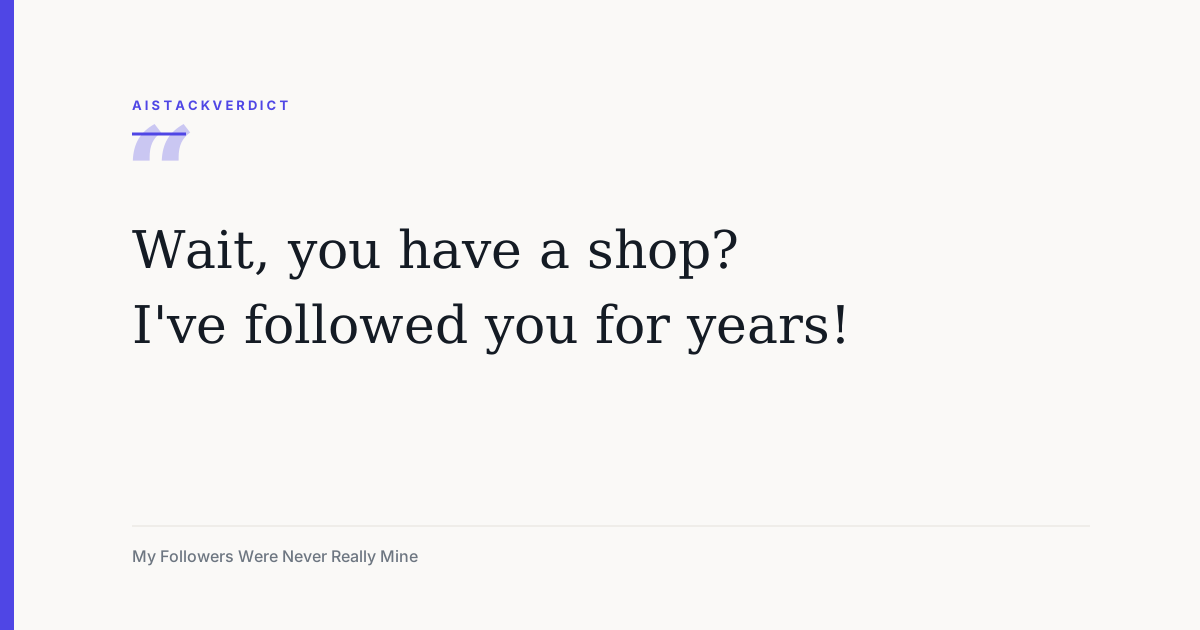
Wait, you have a shop? I've followed you for years!
She was not being careless. She was exactly the person I had made the planner for. She had followed me for years, and she still had no idea it existed. I closed the app, sat on the floor of the spare room, and seriously wondered whether I should go back to a normal job.
What I tried first, and why it failed
- Posting more. More reels, more stories, more behind-the-scenes clips. It ate the hours I needed for painting, and I was chasing a system that could change its mind the next morning.
- Paying to boost the launch post. It put the planner in front of some strangers, but I was renting attention I already thought I had earned, and it stopped the moment I stopped paying.
- A scrappy email list. A basic sign-up form, a spreadsheet of addresses, and a newsletter I sent from my normal inbox with everyone in BCC. It felt clumsy, I never knew who actually cared about what, and I was nervous every single time I pressed send.
That last attempt taught me the real lesson. Email was the right idea. People who give you their email address are telling you they want to hear from you, and no feed decides whether they see it. I just had no proper system for it, so the list sat there, and I kept posting into the void instead.
The turning point
A writer friend who runs a small newsletter kept recommending Kit, which she still sometimes called by its old name, ConvertKit. I finally opened kit.com expecting a complicated tool built for marketing teams with big budgets.
The headline stopped me instead, because it described my exact situation:
Your email list should be working harder for you.
Right under it, Kit says it is 'the email marketing platform that helps you grow your list, find your highest-value subscribers, and earn more from every send.' I read that and thought about my neglected spreadsheet. Mine was not working hard. It was barely working at all.
The other thing that made me take it seriously was the founder story on the homepage. It says Nathan Barry published his first book in 2013, discovered that email marketing works, and found it 'impossibly complicated', so he set out to build something accessible for creators running solo businesses. It also says Kit is 'still bootstrapped' and 'serves creators, not investors'. I can't audit a company's values from its homepage. But 'creators running solo businesses' was the first time a tool had described someone like me, not someone I was supposed to become.
The homepage offers a 14-day free trial with no credit card required, and it mentions free migrations. That meant I could move my scrappy list across and test it properly without handing over my card first. So I did.
How I actually use Kit
Here is the honest version, following the four steps Kit itself uses on its homepage: grow, send, automate, earn. I'm describing the features the homepage advertises and how they fit my small business. This is not a full product tour, and it is not a promise that your results will look like anything in particular.
Growing the list without a to-do list
Kit's promise here is 'Grow your email list, not your to-do list', with no-code landing pages, opt-in forms and newsletter recommendations.
- For me: I built one simple landing page offering a free printable habit tracker, and I put its link in my bio. Now every post has a purpose beyond likes - it points people somewhere I can actually reach them.
- For me: I added a sign-up form to my shop, so buyers can choose to hear about new designs instead of disappearing after one download.
- For me: the homepage lists creator recommendations as a way to reach more people. I'm still learning that side, so I won't tell you more than the fact that it's there.
Sending the right email to the right people
Kit describes its tags and segments as a way to organise your audience 'based on their interests so the right people get the right message at the right time'. Its section title is 'Sell more without being salesy', which is exactly what I needed, because I hate feeling pushy.
- For me: people who download the habit tracker get one tag, people who buy art prints get another. The planner lovers no longer receive emails about framed prints they never asked for.
- For me: I finally stopped writing one newsletter for everyone and hoping it landed. Smaller, more relevant emails feel more like letters to friends.
- For me: the homepage talks about emails that 'build relationships, not just revenue'. That line is why I write about my process and my cat, not only about what's for sale.
Building once and letting it run
The homepage says automations 'welcome new subscribers, nurture relationships, and drive sales 24/7', and calls it 'like having another you in your business'. It also lists Visual Automations among its features.
- For me: a new subscriber gets a short welcome sequence - who I am, why I paint, how to use the free tracker - without me remembering to send anything.
- For me: I set up my next launch as a sequence in advance, so launch week is about answering replies, not frantically writing emails at midnight.
- For me: another 'me' in the business is the best description I've heard. She does the reminders. I do the painting.
Selling without another five tools
In its menu, Kit describes selling digital products with 'simple product pages, automated fulfillment, and low transaction fees'. The homepage also lists paid newsletters, newsletter sponsorships and paid recommendations as ways to earn.
- For me: automated fulfillment is the part that matters. Someone buys a printable, the file arrives, and I don't have to be awake for it.
- For me: I haven't tried a paid newsletter or sponsorships. They're listed, and maybe one day, but I'm not going to pretend I've tested them.
- For me: I can't tell you exact transaction fees, because the homepage says 'low' without giving a number. Check the pricing page.
Connecting the tools I already use
The homepage shows a Kit App Store with apps that connect creator tools directly to Kit. Among the ones it lists are Shopify, Canva, Circle, Linktree, Senja, Thinkific and Transistor.fm. The Canva listing says it gives you access to your Canva library 'natively within the Kit media gallery'.
For me, as someone who lays out a lot of graphics, that Canva connection was a small thing that removed a surprising amount of downloading and re-uploading. The Linktree one matters too, because that's where half my followers find my links in the first place.
The AI part, since this is an AI site
The newest feature on the homepage is Kit MCP. Kit says it lets you 'connect Claude, ChatGPT, Gemini, and more directly to Kit', so AI answers come from your actual Kit data rather than generic advice. The homepage says you can tag subscribers, draft broadcasts and trigger workflows from one conversation, and that you set the permissions and can revoke access anytime.
- For me: I like asking an AI assistant questions about my own list instead of reading generic 'email marketing tips' written for someone else's business.
- For me: I still read every draft before it goes anywhere. An AI can help me start an email. It does not get to speak in my voice unsupervised.
- For me: the fact that access can be revoked anytime is the reason I was comfortable trying it at all.
There's also a feature called Subscriber Signals, which the homepage marks as Early Access and ties to a Pro trial. Kit says it can notify you when a high-value subscriber joins and let you search your list by industry, location or social reach. I haven't used it, so that's all I can honestly say.
What changed, honestly
I'm not going to give you a revenue figure, an open rate, or a before-and-after chart. One illustrator's small shop over a few months is a story, not a study, and I'd rather you trust me than be impressed by me.
What I can describe is how launches feel now. When I release something new, I'm no longer praying to a feed. I write to people who asked to hear from me, and I know the email goes to them rather than to whoever an algorithm picks that morning. Replies come back - real replies, from real people, telling me which page they printed first. And nobody on my list has to discover years later that I have a shop.
The biggest change isn't a number at all. It's that I stopped refreshing. My mood is no longer set by a reach figure I can't control.
Isn't email a bit old-fashioned?
This is the fair objection, and I believed it for a long time. Email felt like something my bank sends, not something an illustrator uses to connect with people who love hand-painted planners.
My answer after living with it: email isn't old-fashioned, it's owned. Social media is still where most new people find me, and I haven't quit it. But it's the front window, not the house. The list is the house. If a platform changes its rules tomorrow, the people on my list are still people I can write to.
The honest other half: an email list is still work. You have to give people a reason to join and a reason to stay. Kit made the system simple for me, but it did not write my letters or paint my pages, and no tool will do that for you.
What I can and cannot verify for you
I want this section to be the reason you trust the rest. Kit's homepage claims 'an industry-leading 99.8% delivery rate and average open rates above 40%'. It says Kit has served '587M+' subscribers and has '13+ years of expertise'. It shows a long list of well-known creators and authors, and testimonials with specific results from other people. I have not audited any of it. Those are Kit's claims and Kit's chosen quotes, not results I measured, and your numbers will depend on your audience and your emails.
On money: the homepage offers a 14-day free trial with no credit card required, and it mentions free migrations, but it doesn't show prices on the homepage itself. So I'm deliberately not quoting a price here. Look at the pricing page before you commit, because plans change and I only want to tell you what I can actually see.
One more small thing the homepage mentions: free access to professional recording studios for Kit creators, located in NYC, Chicago and Boise. I've never been to one, and I live nowhere near them, so I'm just passing that along.
The new Hannah
The old me measured a good day by how a post performed. A good number meant I was talented. A bad number meant I should probably give up. It was an exhausting way to relate to my own work.
The new me measures a good week by the letters. Who wrote back, which design people asked for, what someone printed and stuck on their fridge. That's the connection I wanted when I started painting planners in the first place. It just took a launch nobody saw, and one very honest comment, for me to build a place where my audience is actually mine.
If your audience lives inside someone else's app
If you make things for people online and your only way to reach them is a feed you don't control, you don't have a content problem. You have a landlord. Kit offers a 14-day free trial with no credit card required, which is enough time to move your list across, build one landing page and one welcome email, and see whether it fits the way you work. Do that before you pay anyone, and before you trust any review, including mine.
Disclosure, plainly: this story is written from the point of view of a small, one-person creative business, and everything I couldn't verify is labelled as Kit's own claim rather than a measured result. If you sign up through my link, AIStackVerdict may earn a small commission at no extra cost to you. That doesn't buy a softer review - the launch that flopped is in here, and so is the fact that an email list is still work, whatever tool you choose.
- Hannah
Community discussion
Enjoyed this story? Share your thoughts below.