I teach people how to explain ideas clearly. That's literally in my course description. And for two years, the thing standing between my students and those ideas was me - or more precisely, the slides I built at 1am on Sunday nights, copied straight out of my own research notes. My students weren't bored because the material was bad. They were bored because I had turned every lecture into a wall of text and then stood in front of it, reading.
Who I am
I'm Daniel. I'm a part-time lecturer and freelance tutor. Two evenings a week I teach an introductory research methods course, and the rest of the time I tutor online and write the study guides I sell to former students. It's work I love, but it's also a patchwork life. No department assistant, no design team, no one to tidy up my materials. Just me, a laptop, and a folder of PDFs, Word documents and half-finished spreadsheets that grows every term.
If you teach or train for yourself, you'll know the strange loneliness of it. The actual teaching - the moment a student finally gets it - takes an hour. The preparation takes the whole weekend. And nobody sees the preparation. They only see the slides.
The comment that stung
My process was simple and terrible. I'd open a reading, a paper, or my own notes in Word, then copy paragraph after paragraph into a blank presentation. Title, bullet, bullet, bullet. Change the font. Realise it doesn't fit. Shrink the font. Repeat forty times. By the time I finished, I had no energy left to think about how to actually teach the thing.
At the end of one term, I read my anonymous course feedback at my kitchen table. Most of it was kind. One line wasn't cruel, just painfully accurate:
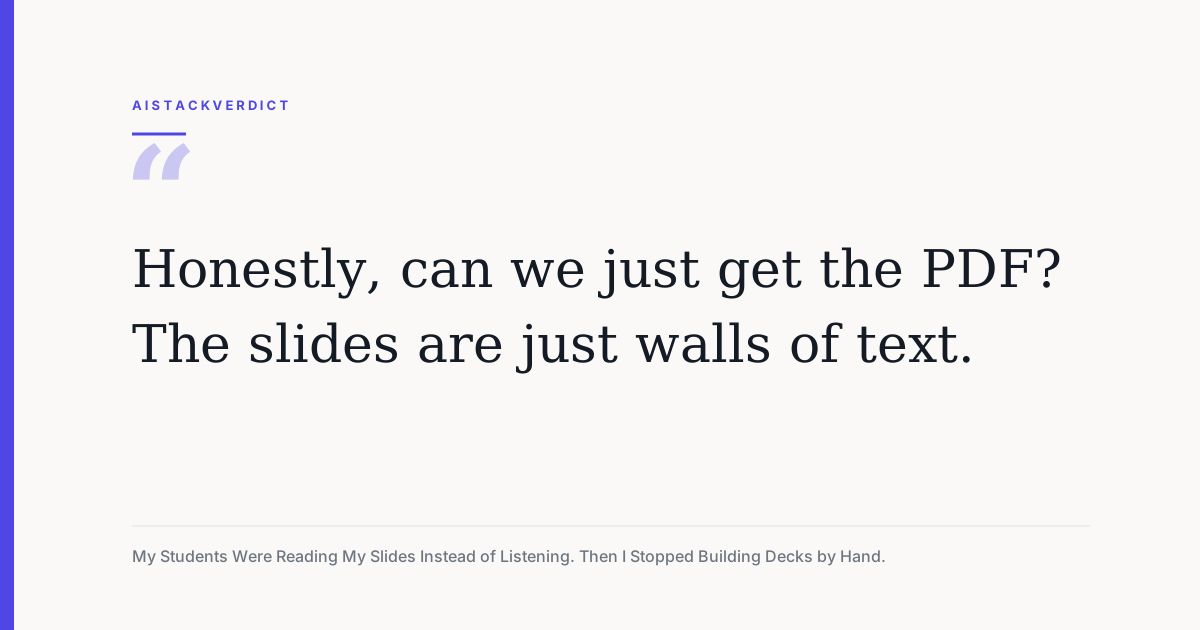
Honestly, can we just get the PDF? The slides are just walls of text.
I sat there for a long time. The student was right. My slides weren't helping anyone learn. They were my notes, projected onto a wall, and I was reading them aloud. Somewhere in the rush of preparing, I had stopped teaching and started presenting a document.
What I tried first, and why it failed
- Downloading free templates. They looked lovely with placeholder text. The moment I pasted in a real paragraph about sampling methods, the layout collapsed and I was back to shrinking fonts.
- Promising myself to 'just write fewer words'. I meant it every Sunday. But summarising a twenty-page reading into clean slides is real work, and at 1am I always took the shortcut of copying and pasting.
- Skipping slides and sharing the PDF. A few students liked it. Most were lost without something on screen to follow, and the lecture felt shapeless.
The problem, I eventually realised, wasn't that I didn't know what good slides look like. It was that turning a document into good slides took more hours than I had, every single week.
The turning point
A fellow tutor mentioned in a group chat that she'd started turning her reading lists into decks with an AI tool. I rolled my eyes a little. I've seen AI slides - generic pictures, vague bullet points, nothing you could actually teach from. But she sent me the link to AiPPT, and the homepage headline was blunt enough to make me click:
AI Presentation Maker for Ready-to-Show Slides
Underneath, it describes itself as 'an intuitive AI presentation creator that turns ideas, documents, URLs, and notes into polished, fully editable slides in minutes.' Two words did the work on me: documents and editable. My whole problem was documents. And my whole fear about AI was ending up with slides I couldn't change.
So I tried it on the reading I dreaded most that week - a long PDF on survey design. I'm not going to invent a stopwatch time for you. What I remember is the feeling: the lecture I'd been avoiding suddenly had a structure on screen, organised into slides, and my Sunday night didn't have to start from a blank page. I actually laughed out loud, alone in my kitchen.
How I actually use it
A quick honesty note before the details: everything below is based on what AiPPT's homepage says the tool does, and how that fits one lecturer's week. It's not a technical teardown, and I'm not promising your deck will come out exactly like mine.
Starting from the documents I already have
The homepage says you can 'start with a topic, paste text, or upload files such as PDFs, Word documents, or URLs'. Its 'Smart Document Parsing' section goes further and lists PDFs, Word files, PowerPoint files, Excel documents, images, or URLs.
- For me: the PDF reading goes in, and a first draft of the lecture comes out. That's the step that used to eat my whole weekend.
- For me: my old PowerPoint decks from previous terms are no longer dead weight. I can feed them back in and rework them instead of rebuilding from zero.
- For me: some weeks I start from nothing but a topic and my own rough notes pasted in. That works well for tutoring sessions I plan the night before.
Editing by talking instead of dragging boxes
This is the feature I didn't know I wanted. The homepage calls it 'Conversational Editing' and says you can 'edit presentations using natural conversation rather than manual slide adjustments.'
- For me: instead of fighting a text box, I describe the change I want - fewer words on a slide, a simpler explanation, a slide split in two - and keep my attention on the teaching.
- For me: this is what finally broke my 'walls of text' habit. It's much easier to ask for less text than to cut my own sentences at 1am.
- For me: I still read every slide before class. AI can organise a reading, but it doesn't know which idea my particular students always get stuck on. I do.
Design I don't have to think about
Under 'Design Refinement', the homepage mentions 'automatic typography adjustment' and 'visual hierarchy optimization'. Under 'Flexible Presentation Themes', it describes 'professionally designed templates built for business, education, research, marketing, finance'.
- For me: education and research are right there in that list, which is exactly my world.
- For me: visual hierarchy is the thing I always got wrong. Everything on my old slides was equally loud, which means nothing stood out.
- For me: I haven't tried every theme, and I won't pretend I have. I found a clean one that suits a lecture room and mostly stuck with it.
Getting it out of the tool
The homepage says you can 'download the final presentation in PPTX, PDF, or image formats', and it also mentions sharing via a link.
- For me: PPTX matters most, because the lecture room computer expects a normal presentation file.
- For me: the PDF export finally answered that student's request. They get the PDF after class - but during class, they get slides worth looking at.
- For me: a share link is handy for tutoring students who just want to review on their phone.
What changed, honestly
I'm not going to give you a number for hours saved or grades improved. One lecturer's experience over a term is a story, not a study, and I'd rather you trust me than be dazzled by me.
What I can describe is how my weeks feel. Sunday nights are for thinking about how to teach, not for copying paragraphs. My slides carry fewer words, so I talk to the room instead of reading to it. I have energy left for the part only I can do - the example, the question, the story that makes a dry method click. And the next round of anonymous feedback didn't mention walls of text. That was enough for me.
Isn't it lazy to let an AI build your lectures?
I asked myself this, and I think it's a fair question, especially from a teacher. Here's where I landed. The AI doesn't know my subject better than I do, and it doesn't know my students at all. What it removes is the mechanical part: moving text from a document into boxes and making those boxes look tidy. That part never made me a better teacher. It just made me a more tired one.
The other half of the honesty: a muddled document gives you a muddled deck. I still decide what matters, I still check every slide for accuracy, and I still cut things that are technically true but not useful for a beginner.
What I can and cannot verify for you
I want to be clear about the line between my experience and AiPPT's marketing. The homepage says 'millions of builders are already turning ideas into reality'. I have no way to check that, so treat it as their claim. The homepage also names several AI models, including Flux, Imagen, Seedream, Nano Banana, Kling and Vidu - I haven't looked into how or where each one is used, so I won't describe them.
On money: the page title calls it a 'Free AI PPT Maker', and the site lists free conversion tools such as PDF to PPT, Excel to PPT and JPG to PPT. But the homepage itself doesn't show plan details or limits, so I'm deliberately not quoting a price or promising what's free. Check the current pricing page before you commit. I also didn't see a list of supported languages on the homepage, so if you teach in a language other than English, test it first.
The new Daniel
The old me thought good teaching meant putting everything on the slide so nobody could say I left something out. The new me knows the slide is there to support the conversation, not replace it.
Now there's a lecturer who walks into class with fewer words on the screen and more to say out loud. Who reads his feedback without bracing for it. Who spends his Sunday evenings a bit more like a human being. It took one honest student and one very uncomfortable evening at the kitchen table to get here.
If your slides are just your notes on a wall
If you teach, train, or present from long documents, and your decks keep turning into walls of text because you simply run out of time, you probably don't need another template. You need to stop rebuilding slides by hand. Take one PDF or Word document you're dreading this week, put it into AiPPT, and see whether the draft gives you your evening back - then edit it until it sounds like you.
Disclosure, plainly: this story is told from the point of view of an independent lecturer and tutor, and everything I couldn't verify is labelled as AiPPT's own claim rather than a measured result. If you sign up through my link, AIStackVerdict may earn a small commission at no extra cost to you. That doesn't buy a softer review - the student comment that stung is in here, and so are the limits of what I can confirm.
- Daniel
Community discussion
Enjoyed this story? Share your thoughts below.